01 Abstract
Audio mixing style encompasses the artistic and technical decisions a mix engineer makes, including level balancing, spatialization, and the choice, ordering, and parameterization of audio effects (FX) on each stem. FX chains are a key determinant of this style, yet existing approaches to modeling them remain limited. Some operate on stereo mixtures without explicit per-stem FX chain modeling, others fix the number or type of effects per track, and many require differentiable effect implementations or scarce multitrack datasets.
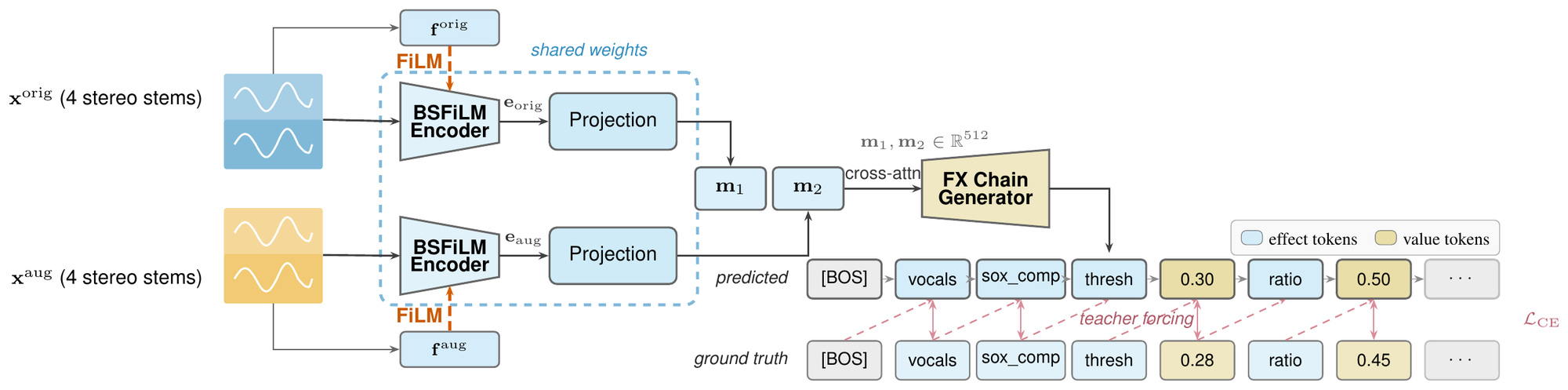
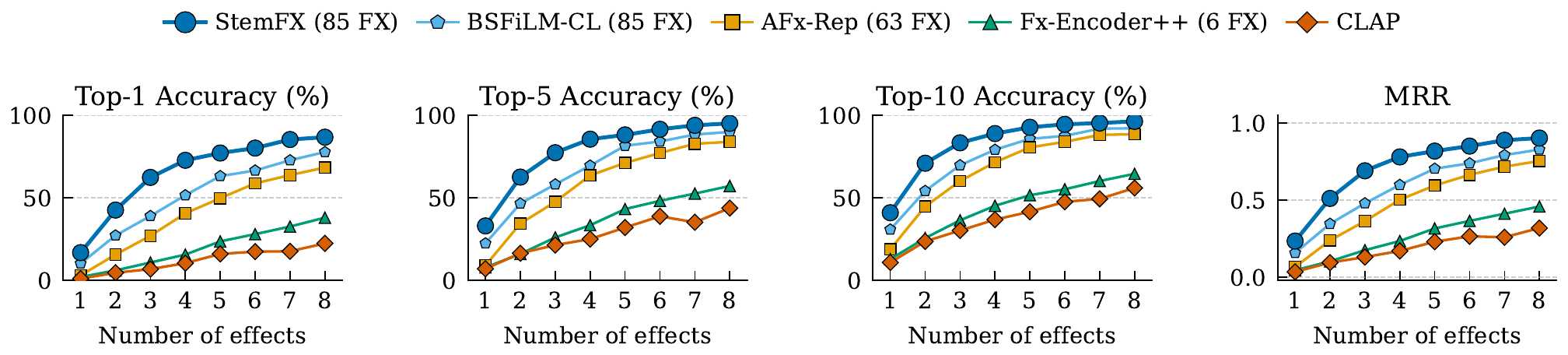
We present StemFX, a framework that learns mixing style representations by autoregressively predicting variable-length FX chains on source-separated stems. A Transformer decoder predicts tokenized FX chains autoregressively, while a band-split multi-band CNN encoder with FiLM conditioning captures per-stem spectral structure. To enable large-scale paired training, we extract pseudo-stems from about 105K songs via source separation and augment them using MultiAFx, a toolkit unifying 85 audio effects from 7 Python libraries. Evaluated on mixing style retrieval, StemFX outperforms all baseline models across all tested chain lengths. On paired mixing style transfer, StemFX achieves the best spectral fidelity and the highest listener preference, over 4000 times faster than iterative optimization.
02 System overview
03 Mixing style retrieval
04 Paired mixing style transfer results
MUSHRA score is the mean rating from 20 listeners on a 0–100 similarity scale, collected on the Real Mix set. StemFX forced and both ITO methods share the same fixed universal signal chain.
| Synth. | Real Mix | |||
|---|---|---|---|---|
| Method | MRSTFT ↓ | MRSTFT ↓ | MUSHRA ↑ | Time |
| StemFX (ours) | 2.35 | 1.44 | 60.6 | 0.24 s |
| StemFX forced | 3.12 | 2.10 | 25.3 | 1.91 s |
| ITO + AFx-Rep | 3.71 | 2.53 | 30.6 | 1033 s |
| ITO + BSFiLM | 2.89 | 2.06 | 19.9 | 1717 s |
| Target mix (high anchor) | 0.00 | 0.00 | 96.6 | — |
| FX-normalized (low anchor) | 3.38 | 1.49 | 54.9 | — |
See the paper for the ablation and dataset-scale results.
05 Paired style transfer — same content, different mix
Headphones recommended. All audio is loudness-normalized to −23 LUFS. The input is the FX-normalized mix; each method predicts an FX chain that should bridge it to the target. Click Show FX Chain to inspect the predicted signal chain, and hover any effect block for its parameters.
06 Unpaired style transfer — different content
Cross-song transfer on MUSDB18, shown in both directions (A→B and B→A). The mixing style of the target song is applied to a different song's content, so no ground-truth reference exists — judge by whether the output inherits the target's sonic character while keeping the original's musical content.
07 Citation
The paper is licensed under CC BY 4.0. Preprint on arXiv:2607.15634.